Saturday, June 12, 2021

Inflation is Jumping

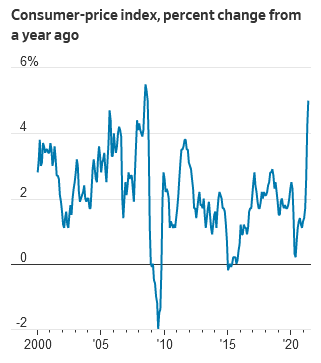
 Inflation is bad for Plano families.  As the value of the dollar shrinks, the cost of caring for your family increases.  If you are retired, the value of your retirement savings shrinks.  The Wall Street Journal recently published, "U.S. Inflation Is Highest in 13 Years as Prices Surge 5%" by Gwynn Guilford, a page one headline on the Friday, June 11, 2021 print edition in your library.  Here is a nice graph from this article.

The gross inflation numbers to not give a truly clear picture for a number of technical reasons.  What is important to realize is that there will be products and services that will individually have costs spiking upward far above the average inflation rate.  Here is a  recent example from within Plano.  Here is the cost of an oil change for me in Plano over this last year.

The cost is 2.5 times now what it was a year ago.  Does that not look like a local inflation rate of 150%?  I think this is due to economic pressures from both competition and Covid.  First, my favorite place for oil changes went out of the oil change business, pivoting to another service.  Then my next favorite place closed its doors during Covid.  Now I have gone to a business that has survived the Covid economic recession by increasing prices.  Also, the new regime in Washington, D.C., has decided to immediately and intentionally raise our costs for gasoline by attacking the oil industry, which also has also increased unemployment in Texas.

I believe some families in Plano are already trying to protect their savings from inflation.  What is your family doing?

PS: My previous article about inflation (a very important topic) was Graphical Displays of Inflation, May 25, 2019, https://planoparents.blogspot.com/2019/05/graphical-displays-of-inflation.html


Sunday, October 4, 2020

Fixing Our Broken Education System

 A friend of mine recently expressed an interest in fixing our broken education system.  I shared with her a few resources to begin looking at the problem.  As she saw it, there was a problem in providing quality education to children.  A child moving from one part of the country to another would find himself either too far ahead of peers or too far behind peers at the new school.  This happened to her children.  She rightly perceived that some schools are not imparting the skills our children need.

 I referred her to an excellent book, Class Warfare: Besieged Schools, Bewildered Parents, Betrayed Kids and the Attack on Excellence by J Martin Rochester (2004), which describes the perspective of a frustrated parent.  It is an excellent book:  https://www.amazon.com/Class-Warfare-Besieged-Bewildered-Excellence/dp/1594030448/


The author, Dr. Rochester is a Professor of Political Science at the University of Missouri-St. Louis.  The book "Class Warfare" speaks of the experience he has lived in combating incompetent education and the results of his research on the depth and breadth of the problem.  His book has 241 referenced footnotes. It is a resource for people starting to look into the problem.  The background is that Dr. Rochester bought a home in what he believed to be a good school district for his children, and then was shocked to find how bad the quality of education truly was.  I recommend this book.

My story is that I was shocked at the deficiencies in my children's education in the Plano schools.  I ran for the Plano ISD (PISD) Board of Trustees a few times to try and fix the math curriculum. There was a disastrous program called "Connected Math" that was crippling math education in Plano.  I found a way to provide my children with tutoring to help them get around the problems with the PISD curriculum.  You find yourself so busy providing your child with the tutoring they need that you give up trying to fix the system.  Then your children graduate and you walk away from the problems at PISD.  I did write about it in this blog to try and help other parents:  https://planoparents.blogspot.com/2010/09/surviving-connected-math-6th-grade.html

 There are many factors leading to failure in the schools.  One is the shift to "student centered" education instead of "teacher centered" education. "A guide on the side instead of a sage on the stage" is their slogan.  A well written book that shows instruction (sage on the stage) is still useful is: "The Academic Achievement Challenge: What Really Works in the Classroom?" by Jeanne S. Chall PhD. Dr. Chall is Harvard professor.  I recommend her book.  https://www.amazon.com/Academic-Achievement-Challenge-Really-Classroom/dp/1572305002/

It is important to recognize that the problems in our schools have been documented steadily for decades.  There was a sensation when the Secretary of Education under President Ronald Reagan issued the report "A Nation at Risk" in  1983.  This statement in the report got attention:  "If an unfriendly foreign power had attempted to impose on America the mediocre educational performance that exists today, we might well have viewed it as an act of war."  It is now 37 years later and our schools have gotten worse instead of better.  Here are a few places where you can access the report. (1) https://www2.ed.gov/pubs/NatAtRisk/risk.html (2) In downloadable PDF https://edreform.com/wp-content/uploads/2013/02/A_Nation_At_Risk_1983.pdf

If you wonder why I say our schools have gotten worse, besides the continuing decline of necessary skills there is increasing evidence of damage to our children, to our society, by teachers and administrators trying to redesign our society by brainwashing our children.  One example is the transgender push, trying to turn boys into girls and girls into boys. Another example is the creation of an army of violent thugs who call themselves "Antifa."  This violence comes from left wing indoctrination in both our  high schools and our universities.  

How can we fix a problem that has been with us for so long?  We begin, I think, by recognizing a pattern of unsolvable problems.  Besides problems in our public schools, we have seen an overlap with problems in our universities.  In God and Man at Yale by William F. Buckley Jr. (1951) we learn that the economics department was promoting Socialism and the university administration was promoting atheism.  (https://www.amazon.com/God-Man-Yale-Superstitions-Academic/dp/089526692X/)  Political indoctrination of our college age children by socialists has been going on for much longer that this: 1951 to 2020 being 69 years.

Another seemingly intractable problem has been poverty in the black community.  The root problem was spelled out in 1965 in The Moynihan Report (https://www.amazon.com/Moynihan-Report-Family-National-Action/dp/1945934298/).  Even then the author Daniel Moynihan mentions that he found the problem well defined in an academic report published in 1950 by E. Franklin Frazier, meaning the root cause has been known for 70 years but the problem remains unsolved.

Why then are these problems apparently unsolvable?  I believe it is because there is a group of people dedicated to maintaining these problems and making them worse.  When Donald Trump became President there was a group of government employees who declared they would resist his efforts to improve our government.  They called themselves "the resistance."  It is people like this who are dedicated to keeping blacks poor, our school children poorly educated, and our college students upset and hostile to our society.

As a member of the Students for a Democratic Society once said, "The issue is never the issue.  The issue is always the revolution."  Until we recognize this underlying thread within of all our long lasting problems we can never solve these problems.

Robert Canright

Friday, September 11, 2020

Communism Is On Our Campuses

 It was brought to my attention that some people on the left have quit calling themselves Progressives or Social Democrats and are admitting they are Communists.  Here is one website our children at college are reading:  HoodCommunist.org.

This picture is from the article "Paradise is not for everyone: Black activists are going to build a utopia city in Florida".  This  young man with the red beret was interviewed by a Russian and the article was translated from Russian to English to be printed in HoodCommunist.org.  Russian Communists have been sticking their noses in the black community for decades, and they still are.  Manning Johnson, a former Communist, described Communist interference in American black communities in his 1958 book, "Color, Communism, and Common Sense."  It is available on Amazon and free in PDF on the internet.

We thought Communism was defeated, but it just licked its wounds and hid in the shadows until it was time to upset our elections by burning buildings.  Our college age students are reading Communist propaganda on our campuses and they believe it.  Instead of teachers in our schools warning the students about the dangers of Communism, they teach our children that America is evil and racist.

We parents must find a way to teach our children about the evils of Communism so they are not so easily suckered when they go to college.

At the very least, every student should read these words from the testimony of Whittaker Chambers to the House Committee on Un-American Activities, 1948:

"I had joined the Communist Party in 1924.  No one recruited me.  I had become convinced that the society in which we live, Western Civilization, had reached a crisis, of which the First World War was the military expression, and that it was doomed to collapse or revert to barbarism. I did not understand the causes of the crisis or know what to do about it.  But I felt that, as an intelligent man, I must do something.  In the writings of Karl Marx, I thought that I had found an explanation of the historical and economic causes [of the crisis]. In the writings of Lenin, I thought I had found the answer to the question:  what to do?"

"In 1937 I repudiated Marx's doctrines and Lenin's tactics.  Experience and the record had convinced me that Communism is a form of totalitarianism, that its triumph means slavery to men wherever they fall under its sway and spiritual night to the human mind and soul." [1]

Repeat this statement, adapted from Chambers, to yourself three times, right now:  Communism means slavery to men and spiritual night to the human mind and soulThere are plenty of facts to back up this statement, but this premise must be made clear to our children: that Communism is evil and dangerous.

Robert Canright

Reference [1]  Witness by Whittaker Chambers, Regnery Gateway, Chicago, 1952, page 541.  This book is also available in audio book.

Saturday, June 13, 2020

A Hispanic Engineer Talks to Young People

I wish to encourage young people to consider engineering as a profession.  I particularly wish to encourage Hispanic children to consider a career in engineering because they are under-represented in this career.  To this end, I have made four videos where I talk to young people about engineering . Below are the links to the four YouTube videos.
  1. Hispanic Robert Canright on the Good in Engineering
  2. Hispanic Robert Canright on the Bad in Engineering.   
  3. Hispanic Robert Canright on the Ugly in Engineering.  
  4. Hispanic Robert Canright on How to Prepare for Engineering.

In the last video I recommended young people read books.  I only mentioned recreational books.  But there are some books about engineering that are entertaining or educational.  Here is a short list.
  1. The Soul of A New Machine by Tracy Kidder.  This is an outstanding book that gives an insider's view of how one new computer was designed.  Not all computer design experiences are like this one, but this one is very interesting.
  2. Getting Sued and Other Tales of the Engineering Life by Richard Meehan.  This book is published by MIT Press and MIT is one of the premier engineering schools
  3. The Existential Pleasures of Engineering, 2nd Edition by Samuel C. Florman.  
I have read all of these books and recommend them. I have not read the following book, but it looks pretty good.  The Design and Engineering of Curiosity: How the Mars Rover Performs Its Job by Emily Lakdawalla.  One of the book reviewers posted pages from the book to show it has lots of pictures and illustrations.  "Curiosity" is the name of a large roving robot we put on Mars.  That is a big deal.
Anyone interested in computer programming should read The Mythical Man-Month: Essays on Software Engineering, 2nd Edition by Frederick P. Brooks Jr.  Here is a link to an obituary of a successful engineer so you can see how much a successful engineer can accomplish:  Harold Chestnut, The accomplishments and life of Harold Chestnut, 1917-2001.  This webpage on Dr. Chestnut has a couple of interesting videos.  This is worth reading and viewing.  He was an electrical engineer.  He also wrote a couple of books on systems engineering.  Not many engineers are this successful, but it gives you an idea of how much can be done in an engineering career.  On the right hand side of this web page is a list of accomplished engineers, dozens of them, and there is a hyper-link to each on.  Thomas Edison is on the list!  This set of web pages is maintained by the Edison Tech Center.  All these web pages and books can give you an appreciation of how varied an engineering career can be.

If you are a young person thinking about engineering, I hope the videos I created for you will be  helpful to you.  My videos are talks about engineering as a career, including the tough parts of the career as well as the good parts.

There are professionally made videos on DVD or streaming video available for purchase from the Great Courses company.  This set of videos is called Everyday Engineering: Understanding the Marvels of Daily Life.  It is a set of 36 videos, each about 30 minutes, that describe the wonderful engineering accomplishments you see in your daily life.  We are surrounded by engineering in our society. 

Robert Canright

Sunday, September 8, 2019

Language Learning with Duolingo. Does it Work? Is it Addictive?

I am a Duolingo user.  I have been using Duolingo to learn German for about a year.  There is almost nothing on the web about Duolingo, so I am writing something here for you. I will start with some Q&A.

Do you really learn a language with Duolingo?  After a fashion you do.  I listened to a German movie, "Das Boot," with English subtitles.  I could pick out a word here and there, but there was one short conversation that I completely understood.  I understood it well enough that I could see the translators did not translate the German precisely, but into an equivalent English idiom.

What is best about Duolingo?  That this app is free is obviously a major advantage.  A lesson takes 5 to 10 minutes to complete.  The earlier, simpler lessons are 5 minutes. Towards the end of a course the lessons are harder and might take 10 minutes.  Short lessons are great.  But here is what is best:  When they give you a sentence in German and ask you to translate it, they say the sentence out loud.  You can then listen to this one sentence repeatedly until your pronunciation matches the Duolingo pronunciation.  This part is great:  you can stab an individual word with your finger and that word is translated for you and it is spoken so you can practice that one word.  You can practice on an individual word.  I have also used the Pimsleur Conversational German course and you can rewind the CD, but you cannot work on an individual word.  The advantage of Pimsleur is that you get to hear entire conversations.

Is Duolingo addictive?  It does seem as though Duolingo Leaderboards can be addictive. If you make your profile public, then you get invited to participate in Leaderboards, a competition.  I have calculated that there are people in many of the leaderboards who spend 20 hours or more per week with Duolingo.  These people get hooked on the desire to finish in the top 3 places in their current leaderboard.  There are times you get your competitive juices going and you want to get promoted to the next league and you do 2 or 3 times more lessons than you objectively want to do.  The leaderboards and leagues have become like games and you want to play to win.

Here is a calulation.  First place player has 2000 XP points (experience points).  You average 12 XP points per 8 minutes.  Do the math and you see that 2000 XP points means 22 hours of play.  That is a bit ridiculous.

You must remember that internet game companies know how to make their games addictive.  Senator Josh Hawley from Missouri wrote an Op-Ed for the Thursday, August 29, 2019, Wall Street Journal entitled, "Big Tech's `Innovations` That Aren't".  The Senator writes, "... the dominant platforms employ behavioral scientists to develop interface designs that keep users online as much as possible.  Bit Tech calls it `engagement.`  Another word would be addiction."  Beyond a doubt you can get addicted to Duolingo competitions.  You look to see where you are in the ranking for your leaderboard.  You watch people above you and people below you.  You find yourself wanting to climb past people. You want to maintain your place on the ladder.  It does get competitive.

Tell me about the Duolingo Leaderboards.  First they place you in a Bronze league leaderboard.  A leaderboard is a group of 50 people. In a Bronze league leaderboard you must be in the top 15, the Promotion Zone, to get promoted to the Silver League.  Once you get promoted you find that the bottom 5 in the list of 50 are in the Demotion Zone.  (Oh no! Don't demote me!)  You are in the top 15 at the end of the week and you get promoted to the Gold League.  Surprise!  The promotion zone now changes to the top 10, so it is harder to get promoted from the Gold League. What do you get promoted to?  They do not tell you.  You have to get promoted to discover you are now in the Sapphire League.  The zones stay the same in the Sapphire league:  top 10 get promoted, bottom 5 get demoted.  What comes next is a mystery.  Duolingo is not informative.  On the Duolingo website there are discussion boards, but they are pretty useless.  Eventually you will find you are like a hamster running in a wheel going nowhere.  Enjoy the leaderboards for a while, but then move on to better uses of your time, like studying a book on German (or your chosen language).

What do you do when you get to the end of your course?  You have learned a lot, but you don't really know the language, so what do you do? On your phone you can scroll up to the top of the list of lessons you have completed and you can start over.  The lesson titles are the same, but the content changes and the presentation changes.  The second time through the course they will play a sentence out loud and you have to pick words from a list to show you understood what you heard.  There is a turtle button to repeat the sentence more slowly.  When you complete the lesson a second time then the crown on your lesson icon changes from showing a 1 to showing a 2.  I like this very much.  Getting to the bottom of a list of lessons is, I think, called "completing a tree."  I do not know at what point you are completely finished with a language course.  I just listened to a fellow Duolingo user discuss on YouTube his experiences and he did not mention repeating the course.

What else do I need to know about Duolingo?  I suggest you also pick up a free translation phone app.  I use iHandy Translator, the free version.  There are times you will find it helpful with your Duolingo lessons.  There are Hearts and Streaks in Duolingo, but you can learn about them on your own.  There are many tricks you can use to help you past tricky parts in the lessons.  When you get an item within a lesson wrong, they repeat it at the end so you are expected to get it right the second time around.   They showed you what you should have done, so it is up to you to remember that when you see the item again at the end of the lesson.  The tool is pretty intuitive.  I like it, but it requires a bit of shrewdness as a user to make the best of the Duolingo app.

The tool does not explain anything.  It is learning by doing.  If you want understanding, you do need a book.  What do they not explain?  Declensions, verb tenses, there is a lot that is not explained.  Even if you can master the formation of sentences in every instance, you won't be able to explain why you do what you do.  Because of this I would say you might learn a language with Duolingo, but you will not master it.

Tips.  Remember I said Duolingo does not explain declensions and verb tenses?  It turns out that there is sometimes a light bulb icon on the button to start a lesson.  Press that light bulb icon and you get a brief grammar lesson.  I have been using Duolingo for about a year and I just discovered the meaning of the light bulb icon.  The Duolingo is not hard, but it is not intuitive.  Let's say Duolingo is partially intuitive.

Conclusion:  Duolingo is definitely worth your time, but it has limitations.  There are Facebook groups for Duolingo that might be useful.  You will find out more about Duolingo by searching YouTube than by searching Google.  If Google has limitations, why shouldn't Duolingo?

Robert

From this website we have a list of the Duolingo leagues: https://forum.duolingo.com/comment/33013171/how-many-leagues-are-there
"...there are 10 as of May 2019. Bronze, Silver, Gold, Sapphire, Ruby, Emerald, Amethyst, Pearl, Obsidian and Diamond."  To put these into list form, the ten leaderboard levels, from low to high, are:

Bronze (lowest)
Silver
Gold
Sapphire
Ruby
Emerald
Amethyst
Pearl
Obsidian
Diamond (highest)

Saturday, May 25, 2019

Graphical Displays of Inflation

They say a picture is worth a thousand words, so here is a great picture of inflation.  Look at the caption in the picture!

That is an easy picture to understand.  Here is a more descriptive graphic from the Federal Reserve.
Chart Title: Consumer Price Index for All Urban Consumers: Purchasing Power of the Consumer Dollar

Double-click on the image to get a better view.  The image is found at this location, from the FED. The chart shows the value of the dollar from 1913 (start of the FED) to today.  If you go to the website you will see that the $1,017 in January 1913 would be worth $39 today.  Another way of saying it is that $1 in 1913 would buy $0.038 worth of goods today.  A 1913 dollar would be worth 4 cents today.  The chart is interactive.  You can move your mouse back and forth over it and the value is visible in a cursor related box.

You might notice the graph says "FRED" at the top.  I think that stands for Federal Reserve Economic Data.  Here is a link to their "About Us" webpage.

We need to get our children to understand that inflation is bad for them and all of us.  Then we need to get our elected representatives to push the Federal Reserve to push inflation back down.

The money you have saved for retirement is shrinking.  The money your children will save for their retirement will be shrinking.  Only the U.S. government likes inflation because it pays its debts with cheapened dollars.

Robert Canright

Link to the inflation thread in this blog:
Teaching Our Kids About Interest and Inflation  April 11, 2015

Sunday, March 10, 2019

The Shrinking Middle Class

I read an article once that said one third of middle class children slip out of the middle class and end up in bad financial circumstances.  I  have seen that happen.  I ran across a nice article by Charles Hugh Smith, Honey, I Shrunk the Middle Class: Perhaps 1/3 of Households Qualify.  I lifted this chart from it:
The illustration indicates that in 1971 the majority of families were in the middle class, but that is not the case in 2015.  If you look at the numbers,  the middle class actually grew in size, but the upper and lower economic classes grew more proportionally.  The fraction of families in the middle class is no longer the majority, but the number of families in the middle class still grew.  This shows how numbers can be interpreted in opposite ways.  The middle class is shrinking!  The middle class is growing!  Both statements are true, depending on your criteria.

The analysis by Mr. Smith is worth your time.  He also wrote another article worth your time and consideration: What Killed the Middle Class?    If we want our kids to be successful, we need to define success; we need to have a good idea of what it means to be in the middle class and what threatens our children staying in the middle class.

Robert

Saturday, February 23, 2019

Inflation in Postage Stamps: Knowing the Formula

The price of a first class postage stamp has in the past gone up a penny or two at a time.  The current increase, just started, was a five cent jump:  from 50 to 55 cents per stamp.  Ouch!  I scratched my head and asked myself, "Wasn't the price a nickel when I was a kid?"  Looking at the History of United States postage rates on Wikipedia, I could see that in 1963 the price was indeed five cents.  I threw the numbers into a hand held calculator and failed to find the aggregate inflation rate.  You cannot just stuff these numbers into hand held a calculator, you have to use the precise formula.  You begin by writing out the compound interest formula and then solving it for the interest rate. As money in a bank increases with compound interest, so the value of money shrinks with the compound inflation.  Here is the formula for compound interest.

Interest in a bank or certificate of deposit compounds monthly, which is why the variable "n" is in the formula.  We will use an aggregate yearly inflation rate, so n = 1 in the equation above.  We have
A = P ( 1 + r ) **t
We started out in 1963 with P = $ 0.05.  We ended up in 2019 with A = $ 0.55.  From 1963 to 2019 is t = 56.   We solve this equation for "r" using algebra.
1 + r = 10.0 ** (log10(A/P) / t)

As I mentioned in an early post,  Calculating Inflation with a Practical Example, August 19, 2018, you can solve this with the Python IDLE GUI, but you have to import the math library first.  Then to find the inflation rate, "r", we subtract 1 and multiply by 100 to get it into percentage.  Division gives us  ($ 0.55 / $ 0.05) = 11.0.  Plugging the numbers into the formula in Python gives
>>> import math
>>> 10.0 ** (math.log10(11.0) /56.0)
1.043749542065121
>>> ( 1.043749542065121 - 1.0) * 100
4.374954206512105
>>>
This means the aggregate inflation rate for postage stamps has been 4.375% from 1963 to 2019, and the cost of postage went up eleven fold.  Back in my August post I calculated that science fiction books went up at rate of 4.22% over this time span for a ten fold increase in the price of paper-back books.  We again that 4% inflation over 50 years drives up costs by a factor of 10.  That is horrible for our children and grand children.  We have been experiencing 4% inflation over our lifetime, with spikes that  have been very high, like in the 1980's under Jimmy Carter.

The Fed Lies to Us

The Federal Reserve has been telling us that contemporary inflation has been about 1% and they wanted to raise it to 2%, but the Fed lying to us because it excludes food and energy prices from the number they quote to us.  From this article:  The U.S. Lies About Inflation, we have these statements:
  • The government-issued consumer price index (CPI) is showing that "core inflation" – which includes prices for all items except food and energy – was up only 1% from last year.
     
  • By excluding food and energy prices, as volatile as they may be, the CPI fails to convey the pain that rising prices are inflicting on American households. Indeed, the true rate of inflation could be closer to 12%.
     
  • The CPI is a joke. Every American knows that in reality inflation is far higher than the CPI tells us based on what they feel in their wallets every day.
     
  • Our research suggests inflation is really running between 9% and 12%, which is more commensurate with what we all feel in our wallets every day.
From this article, Adler: "The Fed's Been Lying About Inflation; It's Frighteningly High", May 18, 2018, we have this statement:  "... the fact is that we really have more – much more – inflation than they’re telling us."

What Should We Do?

We should talk to each other about inflation.  We should talk to our congressmen about inflation.  We need to get inflation and the national debt under control, otherwise we will ruin the lives of our children and grand children.

Robert

Sunday, February 17, 2019

Are You in the Top 1 Percent?

I saw progressives on TV this week railing against "the 1%."  What does that mean?  The top 1% percentile for income is $434,454.80.  There are entire neighborhoods in Plano that fit into that category, but the median household income in Plano is $79,234. I would say many of the people of Plano fall into the 50 to 99th percentiles of income.  Here is a chart of income distribution.  Click on it to see it enlarged.
The graph is United States Household Income Brackets and Percentiles in 2018, Feb. 16, 2018, from the Don’t Quit Your Day Job (DQYDB) blog.  It is a great web page, I recommend looking it over.

How can we know there are people with this income in Plano?  The recommended price for a house is 2 to 2.5 times your gross yearly income.    2 times and 2.5 times the 1% cutoff income is
$434,454 * 2.0 =  $ 868,908
$434,454 * 2.5 = $1,086,135
The most expensive house in Plano at this time is $6,399,000.  The lower end of the top 10 homes in Plano is $2,375,000.  This indicates there are people in Plano with incomes exceeding the cutoff for the 1%.

Who are the 1%?  They are our neighbors.  There is a wide distribution of financial success in Plano.  I see no reason to resent some of our neighbors being more financially successful.  I find contemporary politics disturbingly divisive.  I think the children of Plano should get the education that enables them to pursue a spot in the top 1% of  income if that is what they desire.  There is nothing wrong with working hard and succeeding.

Robert

Sunday, December 9, 2018

Chess and Aquaman

There was a nice article in the 12/9/2018 Sunday New York Times, page ST-8, Aquaman’s Nemesis gets a Chess Lesson by Max Berlinger.  The actor who plays Mantra, Yahya Abdul-Mateen II, likes chess.  Besides being an actor, he has a bachelor’s degree in architecture from the University of California, Berkeley.  He worked as a city planner in San Francisco until he got laid off. 

Now that he is a successful actor, and has time and money to spare, he is taking chess lessons from Douglas Miller in Manhattan.  When he asked the chess teacher how he could improve faster, the chess teacher was reported telling hem he needed to study chess theory.  “Most theory is endgame, and that’s the deepest part of chess. You can easily get a piece to any position on the board, but you have to know how to use it and exploit it.”  The teacher then recommended My System by Aron Nimzowitsch.  I have to disagree a bit here. 

My System is jumping into the deep end of the pool.  It is not the first book a beginner reads.  Better as a first book is The Game of Chess by Siegbert Tarrasch because it has chapters on the opening, the middle-game and the end-game.  Both My System and The Game of Chess have chapters of representative games, however, for beginners the best collection of games to study is The Most Instructive Games of Chess Ever Played: 62 Masterpieces of Chess Strategy by Irving Chernev.  The games actually are selected as examples to show some of the points from My System, that is why the games are called masterpieces of chess strategy.  My System is about chess strategy.

New Ideas in Chess by Larry Evans conceptualizes chess goals as time, space, force, and pawn structure.  He uses about 200 chess positions as teaching examples.  An older player at my high school chess club lent me his copy of this book and reading it improved my play.  It helped me to improve and it will help other beginners to improve.  A beginner needs theory and examples.

Chess offers a life time of enjoyment if you are willing to spend some time in learning the game.  Chess also has the benefit of improving scholastic achievement in young people.  The Canadians have been promoting chess in their schools for a long time.  Here in Plano the Ed Gurukul school, which offers educational enrichment, promotes chess for improved academic achievement.  The Ed Gurukul school offers chess lessons and sponsors the Plano Chess Club, which holds chess tournaments.  How wonderful we have a resource like Ed Gurukul in Plano. 

Robert

PS:  I mentioned Ed Gurukul in a previous article, The Secret to Success in the Suburbs, January 2011.  I am glad this school is continuing to serve our community.

Sunday, October 21, 2018

What is Happening with Apartments in Plano?

There has been a big push by developers to build apartments in Plano.  The problem for the citizens of Plano is that the new apartments are ugly and crowded.  In the past the city leadership in Plano worked to keep Plano an attractive town where we are happy to live.  Under Mayor LaRosiliere the town of Plano is turning ugly.  Let me give you examples.  Here are a few photos of a typical older apartment complex in Plano.


What you see above is an apartment complex set back from the street.  There are trees, bushes, and grass between the apartments and the street.  The apartments are two stories tall and largely hidden by trees.  Now we look at a new complex.


Here you see the new apartment complex is four stories tall instead of two stories.  The apartment complex goes out to the street, without a buffer zone of trees and bushes.  The new apartments being built in Plano are ugly.  Instead of an attractive place for people to live in beauty and serenity, we now have people-warehouses.  There is no dignity in living in giant box like this.  The builders are packing in more than twice as many people per square foot of real estate by building large, ugly boxes to store the unfortunate souls trapped in these soul-killing monstrosities.

What a shame that after so many years of careful stewardship we end up with a mayor who chooses to uglify our beautiful town.  The higher density also adds too much traffic to our streets.   Then there is the increase of taxes on us all by a city government run amok.  You might look at the website of the Plano Citizen's Coalition to keep track of the problems we  in Plano are experiencing with our failed city government.


Monday, September 3, 2018

Life is Not Fair, Part 3 - the Pump and Dump

The August 6, 2018 print edition of the Wall Street Journal had an article, Crypto 'Pump and Dumps' Distort Trading by Paul Vigna and Shane Shifflett on page B1.  The article described how groups of people on the internet drive up the price of various cryptocurrencies in order to sell quickly for quick profit.  The authors described the operation of an internet group called Big Pump Signal.  The article printed charts showing the price over a day of four cryptocurrencies.  You could see the price spike up and then drop.  Occasionally the profitable time for selling is very short.  A person who is lucky in timing trades during a pump and dump can make money if he gets out before the price crashes.

This was an informative and valuable article, but the WSJ did not put it into its electronic edition.  You really must get the paper edition to understand what is happening in the economy because valuable information is cut from the digital version.  Remember that this paper is in many libraries.

You can google Big Pump Signal to find more information.  I found a video on YouTube:
"Big Pump Signal" Crypto Group Review - WARNING: VERY RISKY!
https://www.youtube.com/watch?v=8lv9w5B5kVk

Variations of "pump and dump" happen outside of cryptocurrencies, so this is an investment pitfall your children should know about. You can google "pump and dump" to learn more.

Robert

Sunday, August 19, 2018

Calculating Inflation with a Practical Example

Everyone needs to know how to calculate inflation.  Here is how, with a practical example.  I have an old copy of Glory Road by Robert Heinlein from 1963 priced at $1.75.  Wow!  Today that book sells for $16.99.  To calculate the inflation that drives a book from $1.75 to $17 dollars we set up this equation after calculating (2018 - 1963) = 55:
1.75 ( 1 + x)**55 = 17.0
To solve with python, you first do "import math" into the IDLE GUI.

>>> import math
Here is the solution to the equation.  We all remember algebra, right?
>>> 10.0 ** ( math.log10(17.0 / 1.75) / 55.0)
1.0422044542587574
So 1.0422 is 1 + x, meaning the inflation rate for this book is 4.22% over 55 years.
The average inflation rate is presumed to be 3% as I stated in "Teaching Our Children About Investments" (July 29, 2018), but it is 4% for this book.

Going from $1.75 to $17 is about a 10 fold increase.  I saw this in my lifetime.  I was buying stuff in 1963.  You have to teach your kids that everything they buy today will cost at least ten times more when they are older.  You have to teach them that inflation is a threat to them and their future.  Think about it.  If you have a big basket of groceries and you pay $200.00, like I have done, that same basket of groceries will cost your children $2,000.00 in their lifetime.  It might be 50 years later, but  it is coming like the sunrise if we cannot cannot drop inflation back to about one percent.

Inflation is a hidden tax imposed on us by our own government.  Milton Friedman said in "Money Mischief: Episodes in Monetary History," that, “Inflation is always and everywhere a monetary phenomenon.”  That is a fancy way of saying the government does it to us because it sets monetary policy and controls the money supply.

We all should be getting after our elected officials about inflation and deficit spending.  The mass media, like television news, distracts us away from what is important to us with what I would call "circus sideshows."  They have been running an anti-Trump circus sideshow for about two years now.  They have lost their minds.  Our TV news media are much like Emperor Nero fiddling while Rome burned.

We need to stay focused on what is important to our families and our future.  We should be talking more about inflation among us parents and with our children.
Look at the huge difference between 4% and 2% inflation over our adult life time, which I will call 60 years, which is age 25 to age 85.  (Below is a cut and paste from the Python IDLE GUI)
>>> 1.04 ** 60
10.519627408052855
>>> 1.02 ** 60
3.2810307883654146
This shows prices going up by a factor of 10 with 4% inflation.  That is horrible.  Going up by a factor of 3 is more manageable, which is with a 2% inflation rate.  If we know a bad storm is coming, most people take prudent action.  You either prepare your house to withstand the storm or you evacuate if the storm is too dangerous.  Sometimes people ignore a coming storm and they die.  The future can be dangerous.  Just because the dangers of inflation are in the future is no reason to ignore the dangers.

Robert

PS: I use the Python IDLE GUI as calculator.  You type in an equation and hit the carriage return and you get the answer.  You can install Python by using Google and following instructions.  But that does not give you a useful shortcut on your computer desktop for IDLE.   Here is an article I wrote on how to create a shortcut for IDLE:
An IDLE Shortcut After Installing Python  June 30, 2018

Tuesday, August 7, 2018

Life is Not Fair, Part 2 - Salesmen Get Swindled

How Salesmen Get Swindled

Selling is a talent; selling is a skill.  Selling is vital to companies because not every product sells itself.  Some people might think that the sales profession is inherently dishonest, which is untrue.  Sales is a hard job and a difficult job, but there is nothing inherently dishonest about it.  What people might not realize is that salesmen are frequently swindled by their management.

Territory Reduction

One of the ways a salesperson gets swindled is by having the sales territory reduced.  If a salesman makes more money than his manager, the manager can get jealous and take business away from a successful salesman in order to cut his pay.  Consider the unfairness of this action.  As a salesman you develop a territory and cultivate regular customers.  Then the fruits of your labor are taken away and given to someone else.  One of my neighbors once told me this happened to him.  This is pretty common.

Ewing Marion Kauffman was one of the wealthiest men in Missouri.  He started Marion Laboratories, a pharmaceutical company.  Marion Labs merged with Merrell Dow in 1989, which was then bought out by Marion Roussel Hoechst for $7.1 billion in 1995.

The reason Ewing Kauffman started his business was that he was a successful salesman with a pharmaceutical company, but got swindled.  His company cut his sales territory because Kauffman was so successful that he was making more money than the president of the company. He decided not to look for another job. Instead, he made his own mark on the pharmaceutical industry by starting his own company and doing things his way.

In the book Father, Son & Co.by Thomas J. Watson, Jr., Watson Junior describes how he started his career at IBM by becoming salesman of the year.  His father, Watson Senior, who ran the company, knew of a salesman who had scored a big sale.  The father took the sales territory away from the salesman who worked that territory and gave the territory to his son.  So Watson Junior became salesman of the year without lifting a finger.  Indeed, life is not fair.

Commission Reduction

I remember a story about Circuit City, the bankrupt and defunct consumer electronics store.  At one store a salesman called in for a special meeting before the store opened could see all the top salesmen were called in for the same meeting.  He thought they were going to get some special reward.  The reward they got for their hard was to get fired.  The company decided to cut their commissions, thought the best salesmen would be unhappy about reduced commissions, so Circuit City fired them -- their best salesmen.  The expression, "cut your nose off to spite your face," comes to mind.  Greed and stupidity are boundless.  This story was printed many years ago in the Wall Street Journal.

One former salesman told me directly that after a banner year of sales where he hit all his targets he expected a huge bonus and instead was fired because the owner of the company could not bare to part with the bonus he had promised the salesman.  That is a commission reduction down to zero!

It is incredible to imagine that a salesman would be punished for being a good salesman, but that is greed at work -- the greed of a business owner or a sales manager. 

If your child goes into sales, your child must understand that salesmen do get cheated.  I have only scratched the surface of the unfairness salespeople face.

Robert

PS:  Everyone should know that Ewing Kauffman started the Ewing Marion Kauffman Foundation to promote entrepreneurship.  Also, the book Father, Son & Co. is an excellent book.  I recommend it.

Sunday, July 29, 2018

Teaching Our Children About Investments

Average Rate of Return

I think the first thing a child should learn is what is a reasonable investment return.  Once your child has an investment, say a Roth IRA after starting to work and make money, then your child might be surprised that the investment does not skyrocket out of sight.  The article The Market Isn’t Going to Save You From Saving Too Little by James Mackintosh, July 26, 2018, Wall Street Journal, says, "Since 1900, U.S. stocks have returned 6.5% a year after inflation, including dividends, according to academics Elroy Dimson, Paul Marsh and Mike Staunton."

Inflation

Explain to your child that inflation steals his money.  So if the investment fund says the investment returned 9% last year, and the Federal Reserve claims 2% inflation, then assume the real inflation was at least 3% because the Fed lies about inflation.  Thus a 9% rate of return, minus 3% inflation produces 6% real return, which is like the historical average.

It so happens that the long term average inflation rate in America has been 3.22% per this article:  Long Term U.S. Inflation by Tim McMahon (April 2014).

The Rule of 72

I suggested you teach your children about the Rule of 72 back in April 2015:  Teaching Our Kids About Interest and Inflation.  Now you can point out that 72 / 6% = 12 years for the investment to double.  The investment will grow, but patience is required.  Some other time we might talk about dollar cost averaging.

Safeguarding Savings

I suggest you teach your children to guard their money against losses.  Here is an example I use:  You start with $20,000 in an investment.  It is a risky and volatile investment, so one year you lose 50%.  Now your investment has dropped to $10,000.  The next year your investment bounces back with a 50% gain.  Have you gotten your money back?  Fifty percent down and then fifty percent up, so are you good?  The math says that a 50% gain on $10,000 gives you $15,000, so you are still down $5,000.  It is easier to lose money than to make money in investments.  Investments are a long game. Taking risk for high gains is gambling, it is speculation, but it is not investment.

Hot Shots Like to Crow

I also tell my children that when people they know make a lot of money with an investment, then they might crow about it.  But when they lose a lot of money in the market, they rarely confess their failures.  They will hear plenty about success and little about failures.  Most hot-shot investors profiled in the news eventually run out of luck and hit a stretch of bad luck.  I have steered my children towards mutual funds.  If you do not want to read the book A Random Walk Down Wall Street by Burton Malkiel, you can read the summary of it in Wikipedia.

It is up to us to teach our children!

Robert

Sunday, July 22, 2018

Life is Not Fair - Bad Bosses and Swindles

Bad Bosses

I have decided to explain to my son how life is not fair, and I also decided to share this with other Plano parents.  Our children need to understand the unfairness of life because living in a nice middle-class town -- living in a bubble -- they might not fully appreciate how good a life they have and how tough it can be outside the bubble.

Here are a few examples of how people can lose their jobs unfairly.  John Lasseter, famous for his work at Pixar (Toy Story, Bugs Life, etc.), was fired from Disney for pushing computer animation.  He was fired for being right.  Francis Ford Coppola wrote the script for Patton, and he was fired for writing the iconic scene where George C. Scott stands in front of a large flag and speaks.  Lee Iacocca was manager of the famous Mustang and was eventually fired by Henry Ford II.  Iacocca claims Henry Ford II said: "Well, sometimes, you just don't like somebody."

A common scenario is where you are hired by a manager who likes you and values you.  Then something happens and your manager is replaced by a new manager who hates you.  You might get fired.  You might get treated badly until you leave.  This happens very often.  When a manager who is good to you is replaced by another manager, it might just be a matter of time before you are forced to leave.  It is important to be aware of this, to not be surprised that you go from being valued to being disparaged.  Some people will like you.  Some people will dislike you.  You have not changed, and you have not done anything wrong, but circumstances change and you must leave.  Maybe this seems unfair, but that is life.  This happens so often that someone today at church just told me a similar story:  (1) she was a manager, then (2) her boss quit, then (3) her new boss did not like her, and (4) now she is working elsewhere.

Swindles

It is important to realize a lot of cheating happens in business.  I remember reading about a medical doctor who had a contract with an insurance company that the doctor did not understand.  He naively thought that the insurance company would not offer him a contract that would be bad for him.  After signing the contract he discovered he lost money on every patient.  The doctor went bankrupt because believed in the goodness of people.  But when people work for a company they are sometimes not allowed to be good, they are sometimes required to be ruthless and deceitful.  I read this story about the doctor in a newspaper, either the New York Times or the Wall Street Journal.

Rolls Royce went bankrupt when it signed a contract with Lockheed.  Rolls Royce was losing money on every engine it sold for the Lockheed Tristar jet.  Lockheed held Rolls Royce to the contract and Rolls Royce went bankrupt.  A swindle is legal if you signed the contract and contract turns out to be bad for you.  Sometimes you do not understand that the contract allows you to be cheated.  You can be cheated and it is still legal because you signed the contract.

Here is a recent article: How Regulators Averted a Debacle in Credit-Default Swaps by Gabriel Rubin and Andrew Scurria, Wall Street Journal, July 8, 2018.  Here, Blackstone Group had a credit default swap on a loan made to Hovnanian Enterprises.  Blackstone asked Hovnanian to make a late payment so Blackstone could cash in on some credit default swaps.  Solus Alternative Asset Management felt that was fraud and sued.  A judge said no, it was not illegal.  If conspiring is not prohibited by the contract, then is is legal.

Cheating in business is as old as business.  In the book On Duties by Cicero, Book III within the book is a catalog of swindles.  The ancient Romans were not just conquerors, they were businessmen and well versed in swindling.  On page 122 of On Duties we see Cicero give a definition of "malicious fraud," then he gives some examples.

Sales

I should mention how salesmen get cheated.  Cicero gives examples of how people cheat when selling a property.  But when salesmen are employees, then they too get cheated.  But since this article is getting long, I will save the details of this topic for another day.

Robert

In the same vein as "life is not fair," is "Why ‘Can I Sue My Employer?’ Is Often the Wrong Question" in The Workologist column by Rob Walker, New York Times online August 3, 2018.
Here is the question asked by a reader:  "I have a new boss who is very unfair and abrasive to everyone. Hypothetically, would he be allowed to fire me just because he doesn’t like me? And if he did, what could I do procedurally and legally to fight back? "
Here is the answer:  "As a legal matter, unless you have an employment contract that says otherwise, he could absolutely fire you because he doesn’t like you."
The underlining is mine, added to highlight the point made in this blog entry.


Saturday, May 12, 2018

Business Bio by Alexis Ohanian

I think our children can benefit from the biographies of businessmen.  Alexis Ohanian is an internet millionaire who wrote a book describing how he got rich:  Without Their Permission.  I read it and shared the highlights with my son, which I share now with you so you can share them with your children.

He chose to go to school out of state, going to the University of Virginia instead of going to school in Maryland.  He started a business, Reddit, with his room mate Steve.

Here are the key points: (1)  His room mate Steve had the technical skills to code the website and Ohanian did not have those skills.  (2) Steve did not throw Ohanian over-board like Mark Zuckerberg disposed of so many people.  (3)  Ohanian made the contributions he could, like drawing the spaceman logo for Reddit. (4) Ohanian's biggest contributions were in sales.  He pitched the business to a company called Y Combinator, which provided funding.  (5) Eventually Ohanian pitched the business to the Condé Nast publishing company, making Steve and Alexis Ohanian rich.

And if you are a technical wizard, like Steve Wozniak of Apple, you still need a salesman to make money from your invention.  Sales is a challenging business.  Inventions only make money with sales.  No sales, no money.  You can take that to the bank, or the poor house as circumstances dictate.

Finally, I like to describe to my son the stories of businessmen when their lives appear in the Wall Street Journal Obituaries.

Here is an example from today's newspaper:  Robert Klein Set Up Firm to Help Lenders Protect Homes Going Through Foreclosure by James R. Hagerty, Wall Street Journal, May 11, 2018 (May 12 in the hard copy edition).  The online article has much more detail than the hard copy.

Here are highlights from the obit:

Robert Klein’s father once told him: “God blessed you with a brain and cursed you with a mouth.” Working for a boss would be difficult.


So Mr. Klein, a high-school dropout, was always his own boss, starting as a New York taxi driver and later running his own fruit-and-vegetable wholesaling business in Cleveland. In 1990, he founded Safeguard Properties in the obscure business of mortgage field services. Such firms do foreclosure-related chores for lenders, including changing locks on abandoned homes, sealing broken windows and handling basic repairs so houses can be resold


He started with one employee and grew to around 1,000 as Safeguard expanded nationwide and became one of the largest companies of its type.


Notice he was a high school drop out, yet he provided jobs for thousands of people.  There are more details in the article, such as the business becoming a legacy for the family.

Robert

Sunday, March 25, 2018

Protect Your Children from Income Share Agreements

Loans are Understood and Predictable

Many children have been hurt by large student loans.  I remember an article about a medical doctor who borrowed so much money to become a doctor that she would be paying on her loans to the day she died and would never be able to own a home.

Many young people do not understand loans.  Their parents need to guide them through the process of borrowing money for college.  There have been many night-mare stories of huge debt and meager incomes.  But there are formulas and on-line calculators that allow you to calculate the monthly bill for a loan given the loan amount, interest, and the length of the loan payoff.  With a tool like this you can analyze your potential debt before you commit to the debt. If you google "Loan Repayment Calculator, " then you can see something like this:
(Click on the image to see it expanded.)  You can see that a 6% loan of $20,000 will take $491.05 monthly to pay off, meaning you pay back $29,463, which is $9,463 more than you borrowed.  Many kids graduate with more than $20,000 of debt and many young people will find paying 4491.05 a steep cost.

A $40,000 yearly income, and 28% taxes means a young person will have (40000 * (1 - 0.28))/12 = $2400 per month income and $491.05 is 20% of the monthly income.  Try living in an urban area for less than $1200/month for rent and utilities.  Now you can picture $491.05 as 41% of the remaining $1200 a month after rent and utilities.  A student loan is a serious commitment, but mathematics and planning can lead one to project the economic consequences, including the total cost of the loan.

Income Share Agreements are New and Poorly Understood

Some universities started debt instrument called a Income Share Agreement (ISA)as an alternative to student loans.  Investors wanting to make money off of your children have turned to Congress to pass laws making it easier and safer for them to loan money to your children.

After reading the details of these bills, here are my concerns.
  1. The congressional bills strip away state laws that protect your children from excessive interest rates or claims against their income.
  2. Your children cannot escape a bad ISA through bankruptcy.
  3. These ISAs have an equivalent interest rate and the interest your children pay on ISAs is not tax deductible like a regular loan.
  4. Senate bill S.268 amends the Investment Company Act of 1940 to strip away protections we might have from this law. 
Details from the bills (and web links to them) are at the bottom of this blog posting.

Banks can already loan money to our children, but banks are regulated.  Now a new batch of investors want to own our children's debt without the regulations currently in place to protect our children.  No one can imagine at this time how bad this could be for our children.  We can write our congressmen to protest these bills, but we must surely warn our children to avoid these debt instruments until the dangers are understood.

Your friend and neighbor,
Robert

Details
Senate Bill S.268 — 115th Congress (2017-2018)

Introduced in Senate (02/01/2017)

Investing in Student Success Act of 2017

This bill authorizes an individual (i.e., a student) and another person (i.e., an investor) to enter an income-share agreement (ISA) in which the student agrees to pay a percentage of future income, for a specified period of time, in exchange for funds to pay for postsecondary education, workforce development, or other purposes.

An ISA that complies with specified terms and conditions and meets certain disclosure requirements is a valid, binding, and enforceable contract and is not subject to state laws that limit interest rates or regulate assignments of future income.

The bill amends the Internal Revenue Code to include an ISA as a qualified education loan (a qualified education loan is not dischargeable in bankruptcy), but it prohibits a tax deduction for interest paid on an ISA (interest paid on a qualified education loan is tax deductible).

The bill amends the Investment Company Act of 1940 to exclude as an investment company any person whose business substantially consists of making ISAs.

https://www.congress.gov/bill/115th-congress/senate-bill/268/all-info

House Bill H.R.3145 — 115th Congress (2017-2018)

SECTION 1. Short title; table of contents.

(a) Short title.—This Act may be cited as the “Investing in Student Achievement Act of 2017” or the “ISA Act of 2017”.

SEC. 201. Lawfulness of contracts; preemption of State law.

Any income-share agreement that complies with the requirements of section 102 shall be a valid, binding, and enforceable contract notwithstanding any State law limiting or otherwise regulating assignments of future wages or other income.

SEC. 202. Preemption of State law with respect to usury.

A Qualified ISA shall not be subject to State law with respect to usury, unless such State law was issued after the date of the enactment of this Act and such State law expressly states that it is intended to apply to income-share agreements.

SEC. 203. Preemption pre-existing State laws with respect to ability-to-repay and licensing laws.

A Qualified ISA shall not be subject to a State law with respect to “ability-to-repay” requirements, and an ISA funder issuing a Qualified ISA shall not be subject to any State law with respect to licensing or registration, unless such State law was issued after the date of the enactment of this Act and such State law expressly states that it is intended to apply to income-share agreements.

https://www.congress.gov/bill/115th-congress/house-bill/3145/text